VISUAL MATHEMATICAL REASONING

GraphTheory-VL

Visual instances.
Exact mathematical reasoning.

A diagram specifies the problem. Can a model recover its structure—and compute the exact answer?

Zixiong Yang · Kuo Zhou · Ruwei Pan
Jiaran Gao · Sihan Wu · Lu Zhang

Peking University
Key Laboratory of High Confidence Software Technologies, MoE

FROM DIAGRAM TO STRUCTUREGT-0255
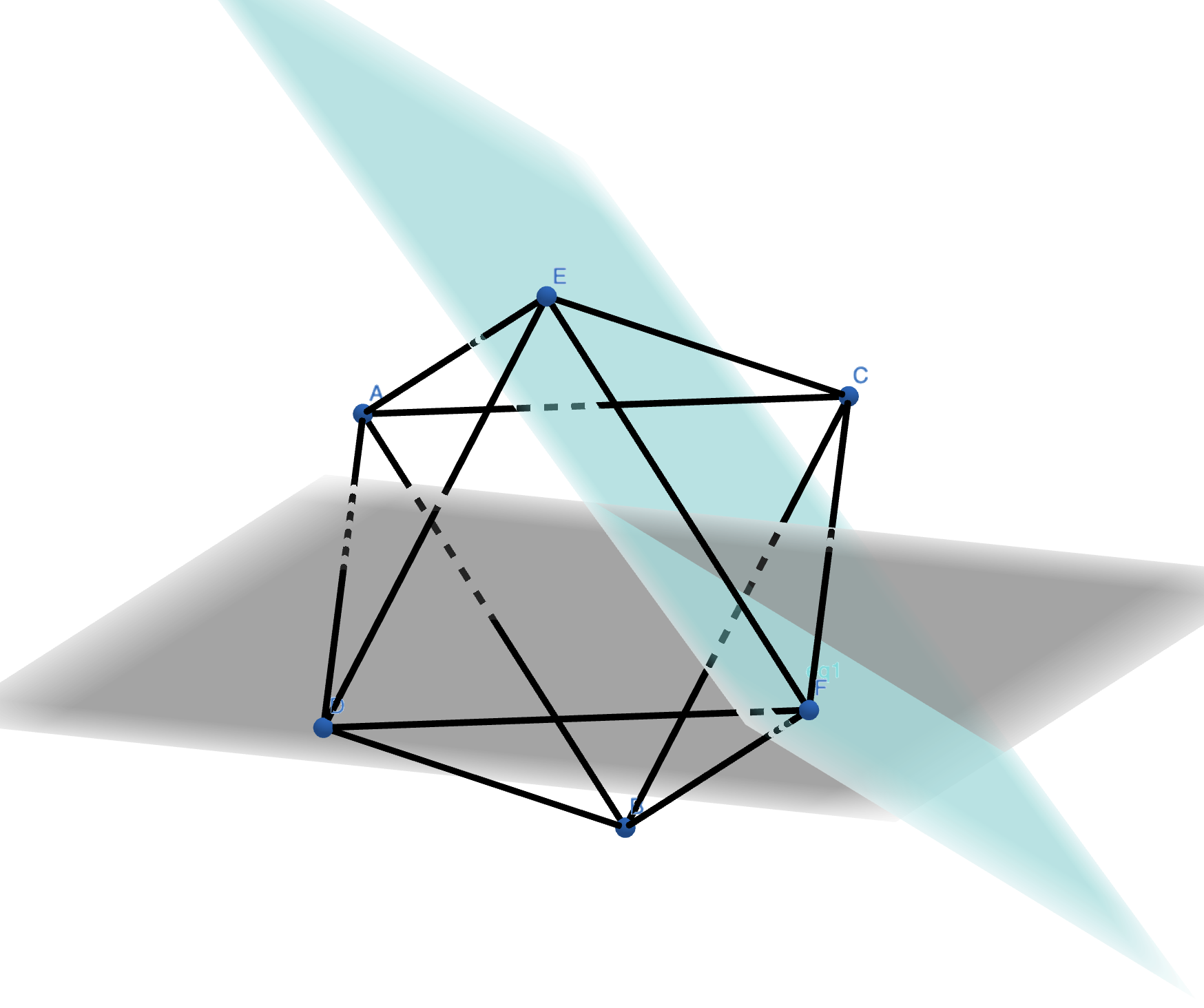
Graph on six labeled vertices with edges passing behind translucent cyan and gray surfaces.
Hidden continuations determine the edge set.
The target is an exact internal-activity polynomial.
62visual mathematics problems
20nested hard problems
3 × 4models × responses per problem
984unique scoring positions

THE BENCHMARK

Read the diagram.
Recover the mathematics.

GraphTheory-VL connects visual instances to graph-theoretic, algebraic and topological targets, with reference answers and archived model responses.

GT-0255Challenge62
Six labeled vertices with black edges partly hidden by translucent cyan and gray surfaces.

Internal-activity polynomial

Recover hidden edge continuations, then compute a spanning-tree polynomial.

Read full question

Introduce \(G\) as the simple graph with labeled vertices \(A, B, C, D, E,\) and \(F\), and let \(M\) be its graphic matroid. The supplied rendering is the complete combinatorial specification of \(G\): each black segment joining two labeled points is an edge, a dashed portion continues an occluded black segment, the translucent gray and cyan surfaces contribute no edges, and a visual crossing without a labeled vertex does not create a new vertex. Read the rendering carefully and recover its full edge topology. Order the edges lexicographically by their unordered endpoint pairs using \(A < B < C < D < E < F\). For a spanning tree \(T\) of \(G\) and an edge \(e\) in \(T\), delete \(e\) from \(T\) to obtain its fundamental cut. Call \(e\) internally active when \(e\) is the lexicographically smallest edge in that cut. If \(i(T)\) denotes the number of internally active edges of \(T\), define the internal-activity polynomial by \(P_G(x) = \sum_T x^{i(T)}\), where the sum is over all spanning trees of the graph recovered from the rendering. Determine \(P_G(x)\) exactly, with integer coefficients and powers written in descending order. Your solution must explain how the hidden dashed continuations affect the edge set, identify the resulting graph structurally, and justify the polynomial through a matroid or graph-theoretic computation. Do not infer extra edges from the geometric placement of segments, and do not discard an edge merely because part of it lies behind one of the displayed surfaces. The answer is one polynomial, not a list of values or a choice among alternatives.

Reference answer

Stored target · v1.0

x^5+7x^4+28x^3+76x^2+139x+133
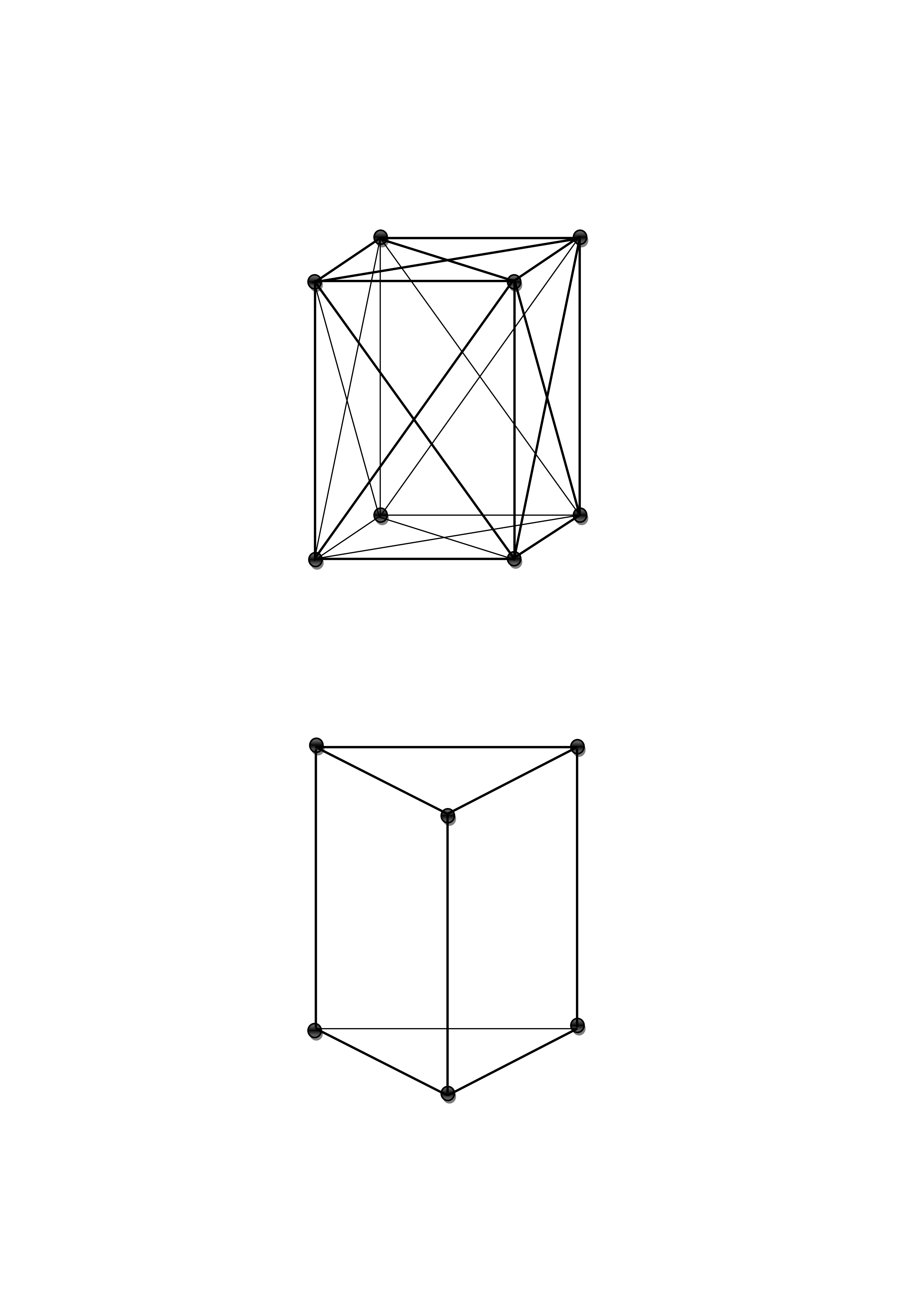
GT-0411Hard20
Two graph drawings stacked vertically, with marked vertices and unmarked crossings.

Critical groups

Read two graphs and determine their critical groups in invariant-factor form.

Read full question

Designate \(G\) and \(H\) as the finite simple graphs encoded by the two drawings, with \(G\) listed first and \(H\) listed second. Every dark circular mark is one vertex, and every straight segment joining two marked vertices is one edge. A crossing without a marked vertex does not create a new vertex, so the vertical segment in the lower drawing passes through the horizontal segment without subdivision. The placement, thickness, and apparent length of a segment have no further meaning, and neither graph has loops or multiple edges.

Read all adjacency relations from the complete drawings. For a connected finite graph \(X\), let \(L_X=D_X-A_X\) be its integer Laplacian, where \(D_X\) is the diagonal degree matrix and \(A_X\) is the adjacency matrix. Delete one row and the corresponding column from \(L_X\), obtaining a reduced Laplacian \(\widetilde L_X\), and define the critical group by \[ K(X)=\mathbb Z^{|V(X)|-1}/\widetilde L_X\mathbb Z^{|V(X)|-1}. \] The isomorphism type does not depend on the deleted vertex. Identify the structural graph forms visible in the upper and lower drawings, then determine the Smith normal form data of both reduced Laplacians. Give the ordered pair \((K(G),K(H))\), using the upper graph first. Each group must be expressed in invariant-factor form as a direct sum of cyclic groups \(\mathbb Z/d\mathbb Z\), with every displayed modulus greater than \(1\) and each modulus dividing the next one. Omit trivial cyclic factors and preserve the order of the two graphs in the final answer.

Reference answer

Stored target · v1.0

[[3,12,48,48],[5,15]]
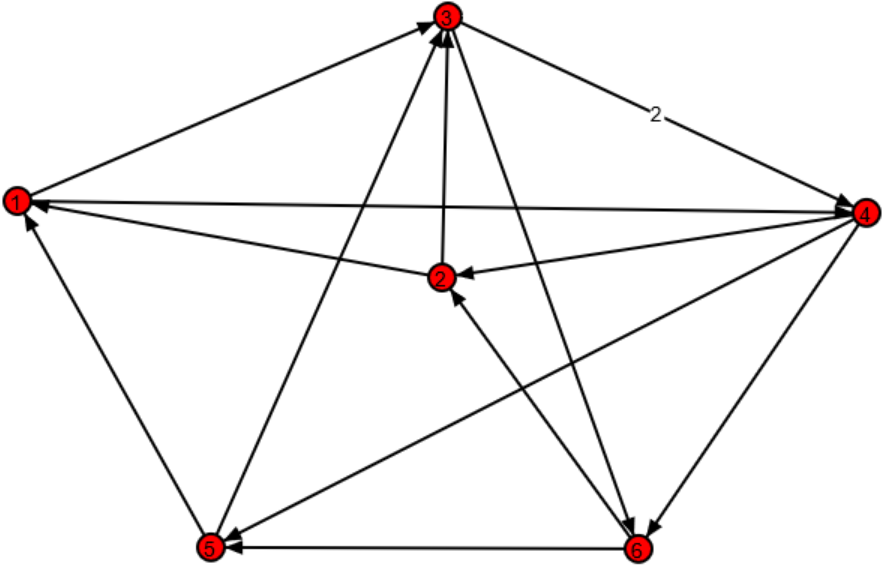
GT-0385Challenge62
A quiver with six numbered red vertices, directed arrows and one arrow with multiplicity two.

Quiver nullspace

Read arrow directions and multiplicities to determine an ordered nullspace basis.

Read full question

In this setup, consider \(Q\) to be the weighted directed quiver on the ordered vertex set \(V=\{1,2,3,4,5,6\}\), with the arrow directions and multiplicities encoded by the complete visual data supplied with this question. Every arrow without a printed multiplicity has multiplicity 1, while the visibly printed multiplicity 2 is to be used exactly as shown. An absent directed edge contributes zero. Do not replace \(Q\) by its underlying undirected graph, and do not identify two opposite arrows before applying the signed convention below.

Define the skew-symmetric integer matrix \(B=(b_{ij})\) by taking \(b_{ij}\) to be the multiplicity of arrows from \(i\) to \(j\) minus the multiplicity of arrows from \(j\) to \(i\). Thus, the ordering of rows and columns is exactly \(1,2,3,4,5,6\), and the sign depends on the arrow direction, not on the geometric slope or position of an edge. Work over the rational numbers, so that the nullspace is a vector space over \(\mathbb{Q}\).

The visual data are indispensable because the edge directions, the single non-unit multiplicity, and the vertex ordering jointly determine \(B\). From this matrix, consider the nullspace \(K=\ker(B)\). To eliminate the usual nonuniqueness of a basis, impose the following normalization. The free coordinates are listed in increasing index order; for each free coordinate, set it equal to 1, set every other free coordinate equal to 0, and solve for the pivot coordinates. The resulting vectors are written as six-entry column vectors in the vertex order above.

Determine the ordered pair consisting of the normalized nullspace basis vector associated with the first free coordinate and the normalized nullspace basis vector associated with the second free coordinate. Your response must be an exact ordered pair, not a numerical approximation, and must preserve the signs and coordinate order. No additional invariant, rank, determinant, or explanatory text is part of the requested answer.

Reference answer

Stored target · v1.0

[[-1,1,1,0,0,0],[1,1,0,1,0,0]]
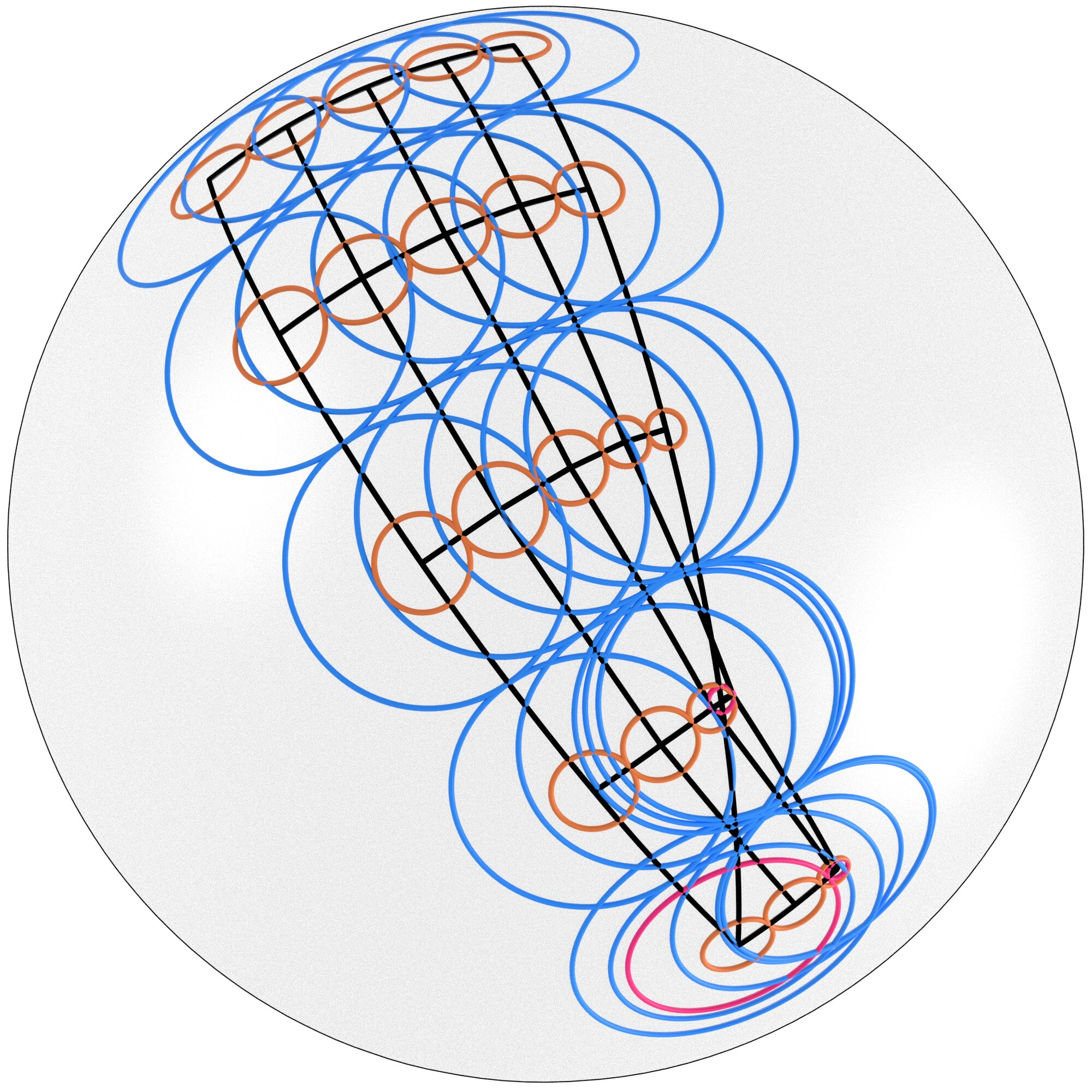
GT-0437Challenge62
A black rectangular mesh with orange, blue and magenta auxiliary rings drawn over its edges.

Vertices, edges and faces

Trace the black mesh through colored overdraw to count its planar structure.

Read full question

Throughout, use \(G\) as the embedded planar graph formed by the thick black orthogonal mesh. Use the complete supplied drawing as the data for reconstructing \(G\), but impose the following precise conventions. Only the black mesh belongs to \(G\). The orange, blue, and magenta rings are auxiliary curves and are not graph edges, vertices, or additional boundaries. The thin large circular outline surrounding the construction is also not an edge of \(G\). Whenever two black tracks meet, their meeting point is one vertex, including vertices on the outer boundary of the black mesh. Portions of a black track hidden beneath a colored ring are understood to continue straight through; the colored overdraw does not split the track or create a new vertex. Tangencies or crossings involving only colored curves are ignored.

The black skeleton is a topological rectangular lattice drawn obliquely: it has two transverse track directions and a finite polygonal boundary. Let \(r\) be the number of elementary black segments along one boundary chain, and let \(s\) be the corresponding number along the transverse boundary chain. These counts must be obtained by tracing the black mesh across the entire drawing, including its upper and lower portions; do not count a cropped local patch or use the colored rings as a substitute for black lattice edges. Let \(V\) be the total number of black-mesh vertices, let \(E\) be the total number of black-mesh edges after the hidden portions are restored, and let \(F\) be the number of connected components of the plane minus \(G\), including the unbounded component. Determine the ordered integer triple \((V,E,F)\).

Reference answer

Stored target · v1.0

(25,40,17)

Four examples from Challenge62. Hard20 is a subset of those 62 problems. Download the four question records.

DATASET COMPOSITION

A selected challenge set.
A harder subset within it.

Selected from a 623-question source pool through model screening and reference-quality filtering.

Challenge6262 problems

Graph theory · Algebra · Topology

Hard2020 of the same 62 problems

RECORDED MODEL EVALUATION

Exact answers remain difficult.

Mean accuracy ranges from 10.89% to 31.85% on Challenge62, and 1.25% to 5.00% on Hard20 with the original images. Each model has four responses per problem.

All rates in %

62 problems · Original images · 744 scoring positions across three models

Recorded results by model. All rates are percentages.
ModelEvaluationAcc@1MeanAccPass@4Stable@4
gpt-5.6-lunaChallenge62 · Original33.8731.8554.8412.90
gemini-3.6-flashChallenge62 · Original27.4228.6343.5514.52
claude-opus-4-8Challenge62 · Original9.6810.8922.581.61
gpt-5.6-lunaHard20 · Original10.005.0015.000.00
gemini-3.6-flashHard20 · Original5.002.505.000.00
claude-opus-4-8Hard20 · Original0.001.255.000.00
gpt-5.6-lunaHard20 · Text-only0.000.000.000.00
gemini-3.6-flashHard20 · Text-only0.000.000.000.00
claude-opus-4-8Hard20 · Text-only5.005.005.005.00

Acc@1 First response correct

MeanAcc Mean over four responses

Pass@4 At least one correct

Stable@4 All four correct

Hard20 Original positions are included in Challenge62 Original. Text-only evaluation is limited to Hard20; a matching target does not establish that the missing diagram was inferred. Download recorded metrics and intervals.

USE GRAPHTHEORY-VL

Data, code and the evidence.

v1.0 · Released September 11, 2026
01 / PAPER

Research paper

Construction, protocol, results and the mathematical cases behind the scores.

Read PDF draft ↗
03 / CODE

GitHub

Offline reading, prediction preparation, label aggregation and reproducibility checks.

Open GitHub ↗

Version 1.0 is available from the GitHub release. Both dataset configurations are also available on Hugging Face. The response archive contains 983 complete outputs and one additional user-reported Incorrect label without its full answer. Download the response archive.

Start with the core package

Python 3.9+ · Standard library only

python3 examples/read_dataset.py --split hard --limit 2
python3 tools/verify_package.py
python3 tools/evaluate.py summarize --output results/local_summary.json

Commands run from the extracted core package or code repository. Reference answers are for evaluation; keep them separate from model inputs. New predictions remain Pending until judged.

ATTRIBUTION

Cite the project.

Cite the released v1.0 dataset using the project attribution below. The accompanying paper is a preprint draft; its identifier will be added when available.

Correspondence: Lu Zhang

Data license: CC BY 4.0
Team-owned code: MIT
Model outputs retain their applicable terms.

BIBTEX
@misc{graphtheoryvl2026,
  author = {Yang, Zixiong and Zhou, Kuo and Pan, Ruwei and
            Gao, Jiaran and Wu, Sihan and Zhang, Lu},
  title = {GraphTheory-VL: Visual Instances for Exact Mathematical Reasoning},
  year = {2026},
  url = {https://limxiong.github.io/GraphTheory-VL/},
  note = {Dataset v1.0; accompanying preprint draft}
}

Download .bib